From Workshop to Championship Stage
Before the ER Champ 2025 Finals in Sofia, two rooms traveled 1,500 km. Built, tested, rebuilt - this is how Dalloway Manor became real.
As we open a new chapter of the championship, it feels only right to look back at the one that closed the previous year - a story of rooms that travelled across Europe before players ever stepped inside them.
In 2025, that story was Boo-tiful Adventure at Dalloway Manor. Players first entered the manor during the stress test. They explored it further throughout the online qualifications. And at the end of that stage, they discovered something unsettling: they hadn’t truly escaped.
The Grand Final in Sofia was not a separate experience. It was the continuation. The doors that seemed closed during qualifications led somewhere deeper. Hidden rooms inside Dalloway Manor were waiting. To bring that final chapter to life, two full-scale escape rooms had to be built from the ground up.
Their journey began in Łódź, Poland.

Three Months in a Workshop
The rooms were created by My Cuda Robimy, a studio that has worked with ER Champ since the championship’s early editions. Over the years, the collaboration evolved into something built on familiarity and shared standards. When work on the 2025 Finals began, there was no discussion about starting from scratch with someone new. The process continued where previous editions had left off.
From first design drafts to the moment the rooms were ready for testing, around three months passed. Both rooms covered 50 square meters. They were separate spaces but narratively connected - two chapters of the same story. Together, they formed the continuation of Dalloway Manor. What players had experienced online was only part of the house.
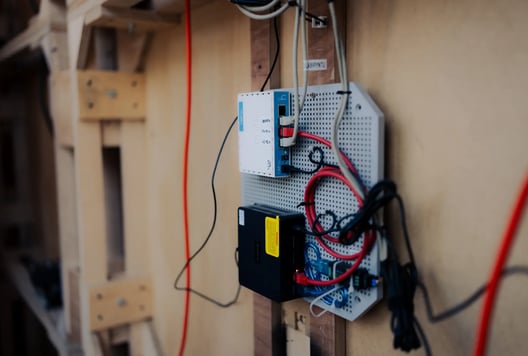
Seventeen puzzles were built into the final structure. Only one relied on a traditional padlock. Everything else operated electronically - sensors, custom mechanisms, integrated systems designed to react precisely and consistently. Electronics allowed the game flow to remain controlled, especially under the additional complexity of livestream production.

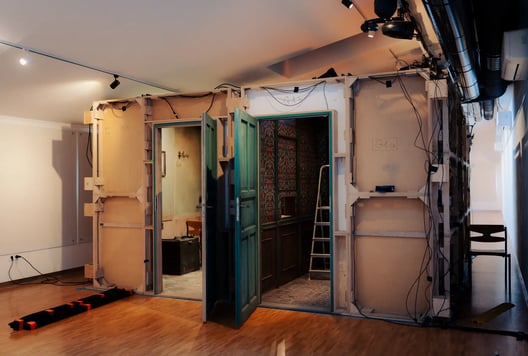
The physical structure itself was built using a modular wall system known as Wonder Wallz. The decision was practical rather than aesthetic, because the Finals are not permanent installations. They are temporary, precise constructions that must be assembled, dismantled, transported and reassembled without damaging the venue. The modular system made that possible. It allowed the rooms to exist fully without permanently altering the space in which they were placed.
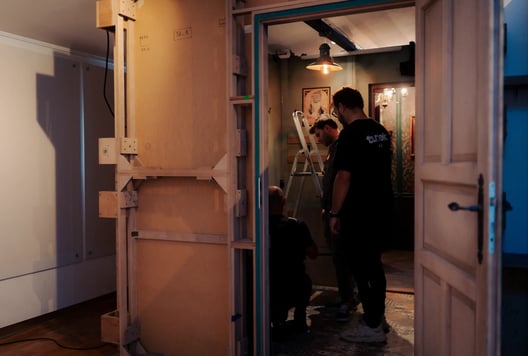
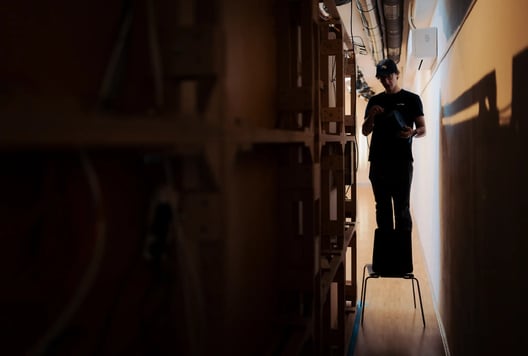
Months of work took place inside a workshop - wiring, mounting, testing mechanisms, adjusting timing, aligning story elements with physical interaction. Seeing the rooms in that stage meant seeing them unfinished, exposed, skeletal - wires visible, panels open, ideas still being adjusted. They were not yet competition rooms. They were prototypes becoming something more stable.
Testing Under Real Conditions
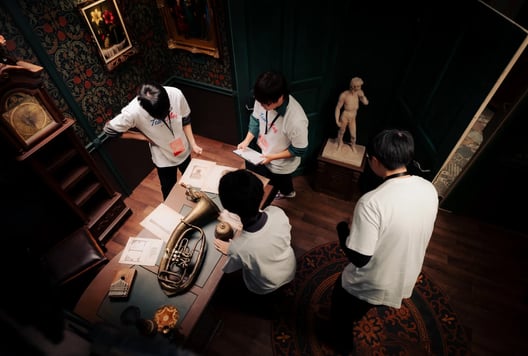
Before leaving Poland, the rooms were played by dozens of experienced escape room teams over several weeks. Testing was not treated as a formality. After each game, detailed interviews were conducted. Structured questions focused not only on whether puzzles were logical, but whether they felt natural. Whether transitions were smooth. Whether players instinctively understood what to do. Whether any mechanism could become vulnerable after repeated use. This phase changed the rooms.
Adjustments were introduced continuously. Some were minor refinements in timing or feedback. Others were structural. One puzzle was removed because it extended gameplay too far beyond the intended rhythm. Another was eliminated due to concerns that, under championship pressure, it might not perform reliably enough.
Removing content is rarely easy. But the priority was stability. In a live, international competition, uncertainty is a bigger risk than ambition. By the time the rooms were approved for transport, they were leaner and more resilient than the first versions built months earlier.
Taking Dalloway Manor on the Road
From Łódź to Sofia, the journey spans more than 1,500 kilometers.
The rooms were dismantled entirely. Walls, electronics, mechanisms, decorative elements - everything was packed separately into one large truck and one smaller transport vehicle. For three days, Dalloway Manor existed only in pieces, secured inside cargo space, crossing borders.

The risks during this phase were obvious - delays at border controls, damage during loading or unloading, a critical component failing after arrival with no time to replace it.
None of that happened. The transport took three days, and the rooms arrived intact. But arrival was only the midpoint of the process.
Eight Hours to Rebuild a Manor
The Finals took place at The Purgatory in Sofia. There, the rooms had to be reconstructed in a single day.
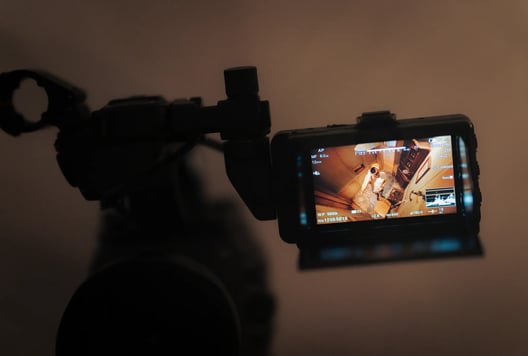
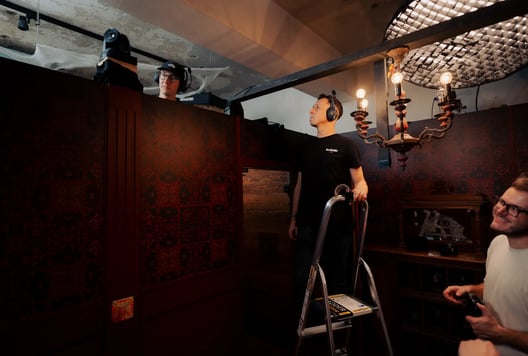
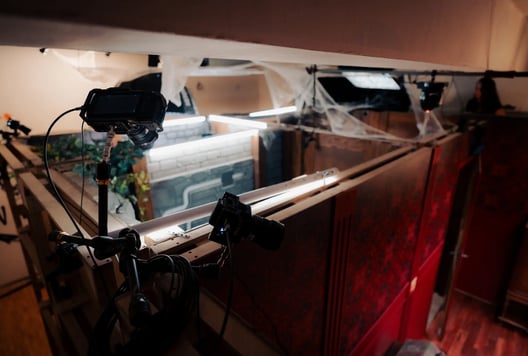
The team from My Cuda Robimy worked alongside local partners from Funky Monkeys. At the same time, Tutek Live - responsible for livestream production, installed lighting and camera systems around and inside the rooms. Walls were going up while cables for broadcast equipment were being positioned. Electronics were being reconnected while lighting angles were tested.
The entire reassembly took around eight hours.
Once construction was complete, the rooms went through full technical verification. Every electronic trigger was tested again. Every mechanism checked. The goal was simple: confirm that nothing had shifted during transport and that every system responded exactly as it had in Poland. There were no last-minute repairs. No emergency redesigns. No technical failures. The most unpredictable part of the process - transport and reconstruction, had passed without complication. The manor stood again.

After the Doors Closed
Once the Finals concluded, something interesting happened. Conversations began comparing the 2025 rooms to those from the previous year. Players and observers pointed out visible progression - in construction quality, in system integration, in structural finish. The modular walls themselves became a topic of discussion, not because they were advertised, but because they felt solid and intentional.
For the team behind the build, that reaction mattered more than any internal assessment. It suggested not perfection, but development. And development is the only thing that keeps a championship meaningful.
For a few days in Sofia, Dalloway Manor existed physically. Players entered rooms that, months earlier, were only sketches and wires inside a workshop in Poland.