Escape Rooms as a Spectator Experience: Bringing the Thrill of Puzzle-Solving to the Screen
Cameras, commentary, and moments of discovery: see how ER Champ brings the excitement of escape room competition to your screen.
A player pauses, looks back at an object, and suddenly calls their teammates over. Something has clicked. Within seconds, the whole team is moving again - and the clock keeps running. Inside an escape room, that moment can feel electric. Bringing it to a livestream takes more than pointing a camera at the players. Viewers need to understand what the team has discovered, why it matters, and what still stands between them and the next breakthrough.
At the World Escape Room Championship, cameras, commentary, and puzzle explanations work together to make those moments understandable and exciting. Here is how we are preparing to bring the ER Champ 2026 Finals to your screen.
Making the Challenge Visible
When you play an escape room, you build your understanding by exploring. You examine objects, test ideas, and gradually discover how the pieces fit together. A viewer joining a broadcast does not have that same starting point.
Without context, a team might appear to be turning objects, studying a wall, or walking repeatedly between two parts of a room. The action becomes much more engaging once you understand what they are trying to achieve.
During the ER Champ Finals, on-screen information will show the elapsed game time for each team being followed and identify which room they are playing in. Puzzle explanations will also appear throughout the broadcast, helping viewers understand the challenges currently facing the competitors.
The aim is to give you enough context to follow the decisions, recognize progress, and feel the significance of a breakthrough - even if this is your first time watching an escape room championship.
Why Viewers Get to Know the Answers
For someone about to play an escape room, revealing a solution would spoil the discovery. For a spectator, knowing the solution can create a different kind of suspense.
You may understand what needs to happen before the team does. You notice a player approaching an important object, then moving away. You hear an idea that could lead to the answer and wait to see whether the others pick up on it.
This is why the ER Champ broadcast includes explanations of how individual puzzles work. On-screen graphics and short videos will demonstrate solutions, giving viewers a clearer understanding of what they are watching.
Knowing the answer does not tell you when the players will find it. That gap between understanding the puzzle and watching a team solve it is where much of the tension lives.

Puzzle explanations help viewers understand the challenge while keeping track of the team and elapsed time. Footage from a previous ER Champ Finals broadcast.
Commentators Connect the Clues
Our commentators know the puzzles and their solutions in advance. That knowledge allows them to explain where the players are in the game, what they are working on, and what seems to be holding them back.
Their role is to connect the action on screen with the logic behind it. A small detail can matter enormously: a missed symbol, an unfinished sequence, or an observation that has not yet been shared with the rest of the team.
Together with the graphics and explanation videos, commentary helps viewers follow those details without having to reconstruct the entire room themselves. Experienced escape room players can appreciate the teams’ approaches, while newcomers have a way into the competition.

The Chest That Required Players to Step Away
One memorable example from a previous final involved a chest connected to a system of floor sensors.
When players entered the space, the chest closed. To discover the hidden sequence of symbols, they had to leave the space and look into the partially open chest from a distance. They could then return and enter the sequence into its locking mechanism. A correct sequence opened the chest fully. An incorrect attempt meant stepping out again, waiting for the lid to lift, and taking another look.
The puzzle challenged a natural instinct: to examine something more closely, you usually move towards it. Here, getting closer concealed the information the team needed.
For viewers who understood the mechanism, every approach and retreat had meaning. The anticipation came from waiting for the players to recognize the connection between their position and the chest’s behavior. Their reactions made it a particularly memorable part of the competition.
Watch the chest puzzle and the players’ reactions on Instagram.
Cameras Inside the World, Operators Outside the Room
Capturing those reactions should not get in the competitors’ way.
As in the previous edition, there will be no camera operators inside the rooms during gameplay. Cameras will be mounted on walls or integrated into elements of the set, allowing the broadcast to follow the action while leaving the space to the players.
This setup gives teams room to move, gather around objects, and focus on their decisions without having to navigate around a production crew.
It also gives viewers different perspectives on the same challenge. One angle can establish what the team is doing, while another offers a closer look at an interaction or reaction that might otherwise be missed.
Choosing What to Show - and When
Several things can happen at once in an escape room. One player may be examining a clue while another tests a mechanism and the rest of the team works elsewhere. Following that activity requires decisions about where to direct the audience’s attention.
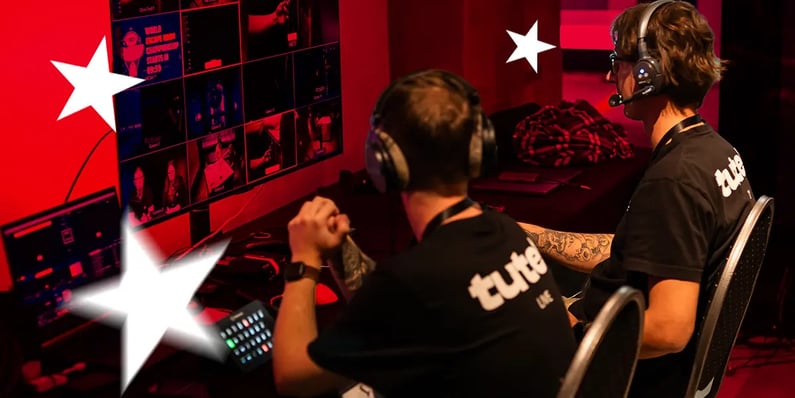
The ER Champ Finals broadcast is produced by Tutek Live, the professional team that has delivered our championship livestreams for years. Their experience with the event helps them recognize important situations and decide when to switch the picture.
Those choices shape how the competition is experienced from home. A useful shot must do more than show movement: it should help viewers understand what is happening and stay with the team as an idea develops.
The result brings together the room cameras, commentary, and explanatory material into a broadcast that viewers can follow from one discovery to the next.

Follow the Main Broadcast or Explore the Room Feeds
For the 2026 Finals, the main livestream will be available on YouTube and Twitch.
Alongside it, there will be two dedicated room streams, one for each final room, with options for viewers to change perspectives as they follow the players.
The main broadcast offers a guided experience of the competition. The separate feeds give fans more choice about where to focus their attention and how to watch the action unfold.
Whether you enjoy the commentary-led coverage or want to spend more time following a particular room, the aim is to bring you closer to the competition.
Bringing the Finals to More Screens
We are also working on a vertical broadcast format designed for mobile viewing.
Plans include a vertical YouTube livestream that could be discovered through the Shorts feed, alongside a possible TikTok broadcast. We are also exploring streaming on Instagram.
These additional options are still in development. The confirmed destinations for the main broadcast are YouTube and Twitch, with the mobile format intended to make following the Finals more comfortable on a phone.
Set Your Reminder for November 14
The Escape Room Championship is full of moments that are easy to recognize: hesitation, determination, sudden understanding, and the relief of finally making something work. Understanding the puzzles brings those moments closer. You can follow an idea as it takes shape, spot an opportunity before the players do, and celebrate when the team finally makes the connection.
The ER Champ 2026 Finals take place on November 14 at Leśnica Castle in Wrocław, Poland. Wherever you are watching from, join us to see the teams tackle the final chapter of this year’s adventure.
The YouTube event page is already available. Open the stream and click “Notify me” to set a reminder — then get ready to cheer on your favorites.